
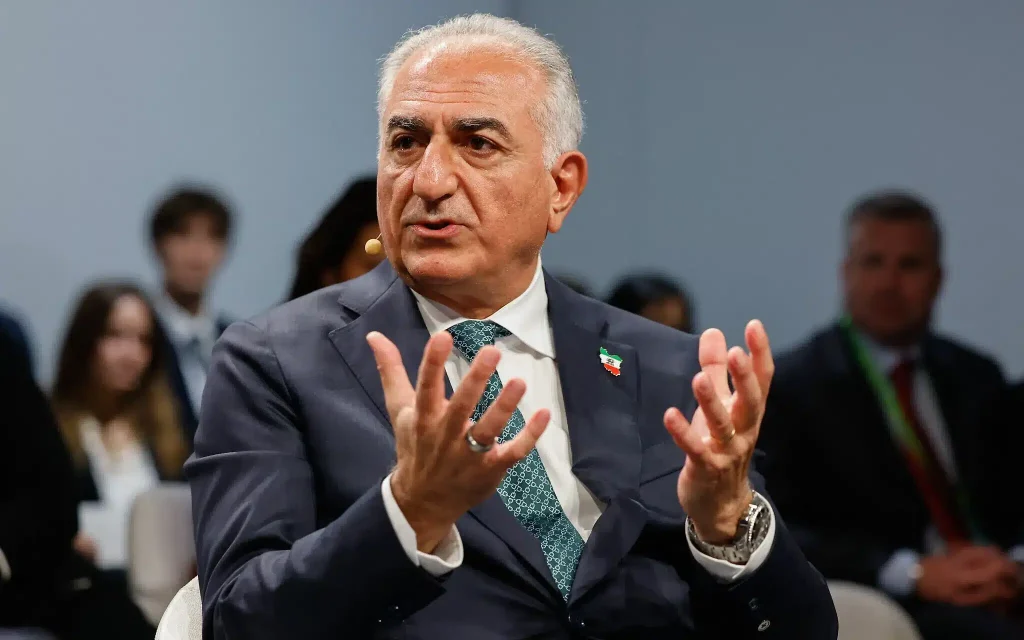
Exiled Iranian Prince Reza Pahlavi Urges American Military Action Against Tehran
Reza Pahlavi, the offspring of Iran’s final shah, has urged the United States to conduct military attacks on Iran, asserting that this could preserve lives and hasten the downfall of Tehran’s clerical regime.
In an interview Saturday, the opposition figure in exile observed that he perceives indications of the Iranian government’s impending collapse and thinks a U.S. strike could either destabilize it further or lead to its downfall.
Pahlavi addressed the media at the Munich Security Conference, where officials from the Iranian government are prohibited from participating.
“It’s only a matter of time.” “We anticipate that this assault will accelerate the process, allowing people to return to the streets and push for the regime’s complete collapse,” remarked Pahlavi, who resides in the United States and departed Iran prior to his father’s overthrow during the 1979 Islamic Revolution.
Iranian officials have detained thousands in a large-scale operation after last month’s demonstrations, the deadliest upheaval the nation has experienced since 1979. Protests began on December 28 as a minor demonstration in Tehran’s Grand Bazaar regarding economic issues and rapidly expanded nationwide.
Trump Challenges Pahlavi’s Backing Within Iran
Iran’s opposition is fragmented among various rival factions and ideological groups, including the monarchists who support the Pahlavi. The opposition seems to have a minimal structured presence within Iran.
President Donald Trump expressed skepticism regarding the level of support Pahlavi truly receives within Iran during a recent conversation, pondering whether the former opposition leader has real backing among the Iranian people.
WLF News obtained information that the Trump administration has been in discussions with Iran to explore the possibility of achieving a nuclear agreement while Washington strengthens its military presence in the area. Last week, diplomats from the U.S. and Iran met in Oman, with additional talks anticipated this week.
“Individuals are anticipating that eventually a determination will be reached that there’s no benefit, there’s no purpose, we’re not going to progress with discussions. “Consequently, it’s time for the United States to step in and fulfill President Trump’s commitment to support the people,” Pahlavi stated.
“Intervention is a method for preserving lives,” he remarked.
On Friday, Trump informed US troops in North Carolina that Iran has proven challenging in nuclear talks and implied that instilling fear in Tehran could be essential to peacefully end the impasse.
Two US officials who communicated with Reuters, speaking on condition of anonymity, indicated that the American military was getting ready for the chance of a prolonged, weeks-long operation against Iran if Trump gives the order for an attack.
The mixed messages from Washington illustrate the careful equilibrium the Trump administration is attempting to uphold between engaging in diplomacy and signaling military might.
Pahlavi advised the administration to avoid prolonged negotiations with Tehran’s religious leaders, claiming that discussions would be unproductive and merely postpone the military action he believes is unavoidable.
His demand for military action conflicts with numerous members of the international community who are concerned that an American strike on Iran might ignite a broader regional conflict and result in significant civilian deaths.
In recent weeks, the Trump administration has sent more aircraft carriers and naval ships to the Middle East, indicating Washington’s preparedness to use military action if diplomatic attempts do not result in a nuclear deal satisfactory to the United States