
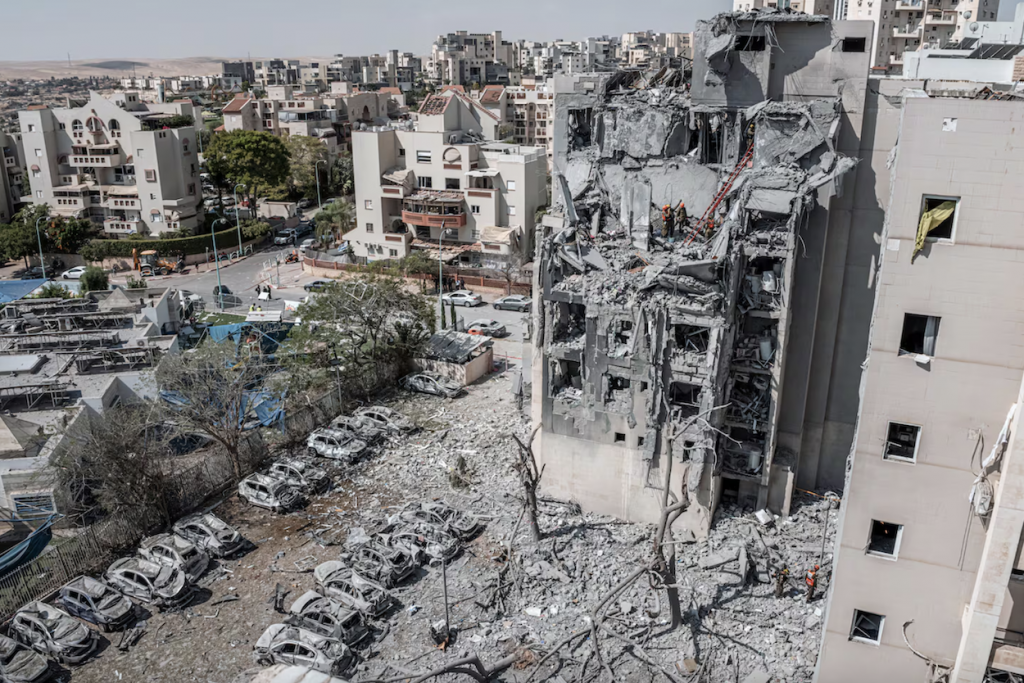
Introduction: ‘Missiles, Nations, and Victory’
For 12 fateful days in June 2025, the world stood mesmerized by Iranian missiles. Wave after wave struck military installations and intelligence centers throughout Israel, a critical proxy of US imperialism that is actively engaged in the first live-streamed genocide in world history, the genocide of the Palestinians. To the world, the missile strikes on Israel represented assaults on Western imperialism itself. Like Haiti, China, North Korea, Kenya, Algeria, Cuba, Nicaragua, South Africa, and countless others before it, and like the Palestinian resistance today, Iran was acting on behalf of the whole Global South, representing all the darkened peoples of the world.Footnote1 Iran’s ongoing support of Venezuela in the face of heightened US aggression, of Russia in its war against NATO, and its earlier support of the South African anti-apartheid struggle reflect this ethos of internationalist resistance.
As the contributors to this Roundtable titled ‘The 12-Day War and the Collapse of US Imperialism’ convincingly argue, Iran ultimately won the war. But the war did not begin the way it ended. It began with an Israeli blitzkrieg attack in the early morning of Friday, June 13, 2025. After temporarily disabling Iran’s air defense systems through a cyberattack, Israel conducted air raids across Tehran and other major cities in the country. The strikes targeted residential areas, killing top Iranian military commanders including Chief of Staff of the Iranian Armed Forces Mohammad Bagheri, Chief Commander of the Iranian Revolutionary Guard Corps (IRGC) Major General Hossein Salami, and IRGC aerospace division commander General Amir Ali Hajizadeh, among others. Israel struck university faculty housing as well, killing Iranian scientists, academics, and their families. Later targets included the headquarters of Iranian national television (IRIB), the Iranian foreign ministry, and critical infrastructure across the nation.
Within mere hours of Israel’s attack, Iran replaced all the assassinated military leaders and began its response. It launched the first wave of strikes against Israel on the eve of June 13. Over the course of 12 days, 22 waves of Iranian strikes followed. Iranians called it True Promise III, in keeping with the series of operations they had launched against Israel during the peak of the genocide in Gaza. Palestinians dubbed it the Iranian Storm, highlighting the nature of the operation as another front in the Battle of Al-Aqsa Flood and the broader Palestinian national liberation struggle against Israel. Notable targets included Israel’s Military Intelligence Directorate, Mossad headquarters, the Israeli Defense Force’s main intelligence headquarters and central command facility, and military bases in Nevatim and Hatzerim. The last two were especially important targets for the Axis of Resistance, as they are notoriously used for aerial operations in the Israeli genocide of Gaza.
From the outset of the war, it was clear that Israel acted with US permission, using US weaponry, air defenses, and political cover. President Donald Trump admitted as much during a Fox News interview on June 15. The next day, he posted an ominous message on social media, ‘Everyone should immediately evacuate Tehran!’, Iran’s capital city which is home to nearly 10 million people. On June 17, he called on Iran to immediately surrender, but the war waged on. And as it did, Iranian missile strikes had an increasing success rate while Israeli missile defenses rapidly depleted. By the weekend, the US was ready to enter the war directly. On Saturday June 22, US bombers struck three nuclear sites in Esfahan, Natanz, and Fordow. Almost immediately, US officials and the media cast doubt on the strikes’ success, saying that Fordow is so far below ground that it’s likely impenetrable. The attack felt like imperial political theater, an effort to save face since by that point the US had consumed almost 25% of its total stockpile of THAAD interceptors.
On June 23, Iran responded to the US, striking the Al Udeid Air Base in Qatar. Al Udeid is home to US Central Command, the largest US military base in the region. There were no casualties, as Iran gave ample notice of this strike to the US. It was largely a symbolic hit, signaling to the US and its allies in the region that Iran is both willing and able to strike with great precision. After all, Iran hit a geodesic radar dome, or ‘radome’, which is a critical component of CENTCOM’s missile defense apparatus. Iran dropped the heaviest barrage of missiles on Israel on June 24, the day after its strike on CENTCOM. Estimates suggest 30 missiles were launched, of which 19 hit their targets.Footnote2 The 12-Day War, as it has come to be known, ended abruptly that day. According to Iran, the US negotiated a cessation of hostilities on behalf of Israel, offering Iran sanctions relief in exchange for the end. According to Israel and the US, they won the war so they stopped.
Israel’s primary goals in the 12-Day War were threefold: to dismantle Iran’s nuclear and missile capabilities, topple the Islamic Republic, and create the conditions for the fragmentation of Iran, as in Syria. This was evident in Netanyahu’s address to the Iranian people on the first day of the war, announcing ‘one of the greatest operations in military history, Operation Rising Lion’. He explained that the objectives of the operation were to defeat the nuclear and ballistic missile threat Israel faced from the Islamic Republic. ‘And as we achieve our objectives, we’re also clearing the path for you to achieve your objective, which is freedom.’ He called on Iranians to stand up against an ‘evil and oppressive regime [that] has never been weaker’ (Goff and Kramer Citation2025). He ended by solemnly proclaiming woman–life–freedom. All the while, Israeli strikes were killing Iranian women.
In the end, Netanyahu’s words reflected incompetence stemming from colonial hubris and fantasy. Iran proved to be resilient across multiple fronts, from its military and technological capabilities to its political apparatus. Much of Israel’s military infrastructure, on the other hand, was struck by Iranian missiles. This is why Netanyahu repeatedly said Israel does not want a war of attrition, because it became clear during those 12 fateful days that Israel does not have the long-term capabilities to handle such a war. Ultimately, Iran’s military might was decisive, but it was not the only significant factor. The strength of the Iranian people was crucial, because as Israeli settlers ran to shelters in fear of Iranian missiles, Iranians poured into the streets to defend their homeland.
US military and economic strength is not what it once was. The US is no longer the most advanced military power in the world. The US dollar is increasingly under attack. The soft power apparatus is contracting due to funding constraints and political differences regarding its effectiveness. And the US faces a polarized domestic front reflected through heightened tensions between state and federal governments – tensions that have now themselves become militarized. The decline is severe enough to impact US proxies, like Israel. The 12-Day War proved that Iranian missiles can deplete US defenses within months and even weeks. And without those air defenses, Israel is highly exposed.
The short war revealed that the global balance of power is slowly shifting, due to economic, military, and political factors. If gunpowder once enabled the rise of Europe and its subjugation of the world, today it appears that missile technology is powering the rise of Asia and its growing independence. In this groundbreaking collaboration, anti-imperialist scholars from Iran and the US collectively excavate the military, economic, and ideological architecture of the 12-Day War vis-à-vis the collapse of US imperialism. This is the first of a three-part collaboration that includes an international conference and will culminate in a larger Special Issue called ‘Iran in the World’.
___________________________
Who won the war? This is the debate that continues to plague scholars and opinion leaders. The question of victory begs deeper analysis and further exploration, and is one of the subjects of this Roundtable. During the war, Israel murdered over 1,000 Iranians, mostly civilians; approximately 30 Israelis were killed. Iran suffered heavier casualties than Israel because while Iran largely focused on military targets, Israel hit residential areas and civilian infrastructure. But civilian losses are not an accurate measure of victory in modern warfare, especially in light of the respective asymmetry between the US and its heavily armed Israeli proxy, on the one hand, and Global South nations like Iran on the other. Casualties and infrastructural damage can be measures of tactical achievements, but not strategic aims or broader victory (Bartholomees Citation2008). According to Major General James Bartholomees, recently appointed to the US Army’s 25th Infantry Division in Hawai’i after serving as the US Army Pacific’s Chief of Staff, the traditional concept of victory is based on reducing the enemy’s means of resistance (Bartholomees Citation2008). This approach can be implemented in a few different ways: ‘destroying or neutralizing the enemy’s military or at least attriting it to the point of ineffectiveness’, or using ‘paralysis to avoid the issues of destruction or attrition’ (34). The latter approach is focused on disrupting vital systems like command and control to make resistance ineffective (Warden Citation1995).
Israel and the US commonly use the paralysis approach, hitting command and control targets and committing decapitation strikes against top officials, while Iran and the broader Axis of Resistance continue to apply attrition. The 12-Day War between Israel and Iran exemplified this battlefield collision of divergent strategies. For Iran and the Resistance, attrition serves as both strategy and goal, because a weakened or attrited Israel can no longer colonize and genocide Palestine or terrorize the other nations of the region, Iran included. In fact, during the war the Iranians announced that they were waging a war of attrition against Israel and had the weapons stockpile on hand to continue for at least two more years. The Iranian strategy has since quickly evolved to integrate the new shifts in the regional order and the knowledge gained through the 12-Day War, according to contributors Mohammad Jamshidi and Mostafa Mohammadi. In this context, attrition is a tool of national liberation that undergirds Iranian sovereignty and strength, even and especially in the new environment, as Navid Farnia asserts. Toussaint Losier explicates US grand strategy in the context of diminishing military capabilities, a weak US economy, and intractable global competition with China.
If one measures the outcome of the war against Israel’s initial objectives, it was largely a strategic failure sprinkled with tactical wins. Tactical wins like relatively higher civilian and military casualties can be significant in warfare, but they are not always so. In this case, such tactical gains did not prove determinative at the strategic level. Israel did not achieve the battlefield objective of disrupting Iranian command and control to make resistance ineffective, and it did not realize the political aims of toppling the Islamic Republic, undermining Iran’s missile capabilities (as of now there is no evidence it significantly disrupted Iran’s nuclear capabilities either), or fragmenting Iran. Quite the contrary. As Reza Bagheri, Zahra Taheri, Elaheh Karimi Riabi, and Zeynab Bahrami argue, the war united Iranians around the world.
During the war, Iranians across the country poured into the streets in a spectacular show of support for the Islamic Republic and for Supreme Leader Ayatollah Khamenei. And around the world, Iranians of different political stripes rose up in defense of national sovereignty. While this political unity and loyalty to nation may have been an unpleasant surprise for the Pentagon and its Israeli equivalent, Bagheri, Taheri, Karimi Riabi, and Bahrami explain the ancient roots and modern manifestations of Iranian nationalism, extending through millennia into the present. Iran is, after all, one of the oldest continuous nations in the world. That is no accident of history. Elham Kadkhodaee evokes Franz Fanon to remind us that the decolonized spirit persists though space and time, even amidst the most violent efforts to recolonize both the minds and the lands of the region.
Of course, 100 years of US-led colonialism, warfare, and incremental genocide in West Asia have been devastating (Capasso and Kadri Citation2023; Pappe Citation2014). For over a century, the peoples of the region who were lucky enough to survive have borne the multifaceted burdens of imperial subjugation, including dependence, migration, and exile. In her article, Zeinab Ghasemi Tari describes the decades-long ontological genocide that upholds the physical genocide in the region. Setareh Sadeqi and Chris Weaver remind us of the ideological underpinnings of this genocide and dehumanization. The US–Israeli war on West Asia is neither exceptional nor specific, however. Nick Estes labels US imperialism as one long Indian War. The colonizers started over 500 years ago and they haven’t stopped yet (Kadri Citation2023). But today, finally, US imperialism is dying, and it is taking the Western, white world order to which we have been subjected for generations along with it. As Western capitalism falls, according to Roohollah Kohanhoosh Nejad and Seyyed Mahdi Pakzat, contradictions will heighten and aggression will continue. Israeli wars, like the Indian Wars, act as primitive accumulation for the forces of imperialism, even at its end.
In short, the Western world order can no longer sustain long, hot wars. The NATO-led war in Ukraine, the Israeli war on the Axis of Resistance, and decades of wars before have drained the empire’s resources. It now turns to short, sequential wars to discipline and plunder the Global South, in hopes that someday it can rebuild the capacity to retake the planet.
We live in unprecedented times. For nearly 600 years Europe and the US have ruled the planet, plundering its resources and pillaging its people. During this period, Western colonialism spanned nearly the entire globe. But those days are at an end. It is difficult to estimate how long the process of emancipation will take. The next phase of human struggle following emancipation will be to rebuild, and to save the planet and its remains. It is in this context that Brahim Rouabah and Corinna Mullin conclude this Roundtable with their clarion call: ‘The road to human liberation today runs not only through the streets of Paris or New York, but also through the skies over Tehran, the waters of Yemen, the hills of South Lebanon, and the rubble of Gaza.’ As the East rises and the South dawns again (Yi Citation2025), the Western left faces an everlasting question brought to the fore by Max Ajl, which side are you really on?
Nina Farnia
nfarn@albanylaw.edu
Albany Law School
Disclosure Statement
No potential conflict of interest was reported by the author(s).
Notes
1 This statement reflects the author’s discussions with anthropologists and sociologists during a forum on US imperialism.
2 The Iranians were also using cyberwarfare to disable Israeli missile defenses and create vital gaps that enabled Iranian missile penetration and accuracy.
References
- Bartholomees, J. B. 2008. “Theory of Victory.” Parameters 38 (2): 24–36. https://doi.org/10.55540/0031-1723.2419. https://press.armywarcollege.edu/cgi/viewcontent.cgi?article=2419&context=parameters#:∼:text=Page%204,likely%20to%20be%20widely%20accepted(open in a new window).
- Capasso, M., and A. Kadri. 2023. “The Imperialist Question: A Sociological Approach.” Middle East Critique 32 (2): 149–166. https://doi.org/10.1080/19436149.2023.2176943.
- Goff, B., and T. Kramer. 2025. “Netanyahu Urges Regime Change in Iran.” DW. Accessed October 15, 2025. https://www.dw.com/en/netanyahu-urges-regime-change-in-iran/video-72904211#:∼:text=08:31,and%20reporter%2C%20based%20in%20Jerusalem(open in a new window).
- Kadri, Ali. 2023. The Accumulation of Waste: A Political Economy of Systemic Destruction. Leiden: Brill Publishers.
- Pappe, Ilan. 2014. “Israel’s Incremental Genocide in the Gaza Ghetto.” Electronic Intifada. Accessed October 12, 2025. https://electronicintifada.net/content/israels-incremental-genocide-gaza-ghetto/13562(open in a new window) .
- Warden, John A., III 1995. “The Enemy as a System.” Airpower Journal 9 (Spring): 41–55.
- Yi, Wang. 2025. “Practicing True Multilateralism and Building a Just and Equitable Global Governance System.” Accessed October 12, 2025. https://www.fmprc.gov.cn/eng/wjbzhd/202502/t20250219_11558555.html(open in a new window).