
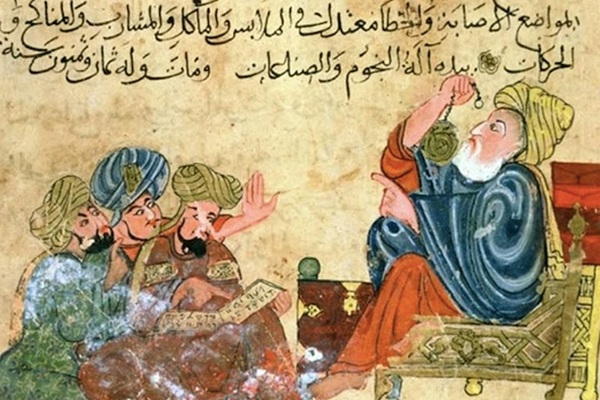
The translation movement during the early rise of Islam was not merely a linguistic exercise; it was a massive, state-sponsored intellectual project that directly caused a scientific revolution. By systematically translating the knowledge of ancient Greek, Persian, Indian, and other civilizations into Arabic, Islamic scholars preserved this learning and used it as a foundation for groundbreaking advancements that would later influence Europe’s Renaissance .

The table below summarizes some of the most influential scholars and their key contributions.
| Scholar/Translator | Primary Field | Key Contributions |
| Hunayn ibn Ishaq | Medicine, Translation | Master translator of Greek medical texts (Galen, Hippocrates); known for exceptional accuracy and methodology. |
| Al-Khwarizmi | Mathematics, Astronomy | Founded algebra; introduced Arabic numerals; his name inspired the term “algorithm”. |
| Thabit ibn Qurra | Mathematics, Astronomy, Translation | Translated and revised Greek mathematical works; made contributions to geometry and astronomy. |
| Al-Kindi | Philosophy, Mathematics | Known as the “Philosopher of the Arabs”; worked on integrating Greek philosophy with Islamic thought. |
| Avicenna (Ibn Sina) | Medicine, Philosophy | Authored The Canon of Medicine, an authoritative medical encyclopedia in Europe for centuries. |
| Al-Razi (Rhazes) | Medicine, Chemistry | Identified smallpox and measles; challenged Galen’s theories; pioneered controlled experiments. |
The Engine of Translation: Institutions and Patronage
This scientific revolution was driven by a powerful combination of institutional support and intellectual curiosity.
– Centralized Centers of Learning: The House of Wisdom (Bayt al-Hikma) in Baghdad, established by Caliph Harun al-Rashid and greatly expanded by his son Caliph al-Ma’mun, was the epicenter of this movement . It functioned as a library, translation institute, and research academy, attracting scholars from diverse cultural and religious backgrounds .
– Strong Government Sponsorship: Abbasid caliphs invested enormous resources, paying translators like Hunayn ibn Ishaq salaries comparable to professional athletes today to ensure high-quality work . This patronage was a strategic investment in knowledge and cultural prestige .
– Key Enabling Technology: The adoption of paper-making technology from China replaced expensive parchment and fragile papyrus, making books cheaper to produce and knowledge more accessible, which fueled the “cult of books” in Arabic society .
From Preservation to Innovation
The translation movement’s impact extended far beyond preserving ancient texts.
– Creation of New Sciences: Scholars did not just translate knowledge; they built upon it. The work of Al-Khwarizmi and others essentially created the new field of algebra .
– Refinement of the Scientific Method: Scholars like Ibn al-Haytham (Alhazen) emphasized experimental verification and rigorous research procedures, laying groundwork for the modern scientific method. Centuries later, European scientists like Galileo and Boyle still referenced his work .
– Bridging Civilizations for Europe’s Revival: The translated and enhanced Arabic texts were later translated into Latin in centers like Toledo, Spain. This transfer of knowledge, which included the works of Aristotle and Avicenna, was a primary catalyst for the European Renaissance and Scientific Revolution .
The Legacy of the Translation Movement
The translation movement of the Islamic Golden Age demonstrates the power of open-minded inquiry and cross-cultural exchange. It shows that scientific progress often depends on the ability to gather, translate, and build upon the knowledge of all available civilizations.
I hope this overview helps clarify the crucial role translation played. If you are interested in a specific field, such as medicine or astronomy, I can provide more detailed information.