
The history of the Western world over the last 300 years is a complex tapestry of revolutionary ideas, catastrophic wars, immense technological progress, and profound social change. It’s a story of the rise, dominance, and transformation of Western power on the global stage.
Here is a structured overview of the main events and themes, incorporating the specific elements you mentioned.
The “Long 19th Century” (c. 1789-1914): Revolution, Industry, and Empire
This period is defined by the twin forces of the Industrial Revolution and political revolutions, which together created the modern world and fueled Western global dominance.
- The Age of Revolution & Enlightenment Ideals
The American Revolution (1775-1783): Established a republic based on Enlightenment principles of popular sovereignty and individual rights, challenging the old order of monarchy.
The French Revolution (1789-1799): A more radical and violent upheaval. Its ideals of “Liberty, Equality, Fraternity” and the rise of nationalism reshaped Europe. The subsequent Napoleonic Wars (1803-1815) spread these ideas across the continent.
- The Industrial Revolution
Beginning in Britain in the late 18th century, it transitioned economies from agrarian to industrial. This created immense wealth, new social classes (the industrial bourgeoisie and the proletariat), and massive urbanization, but also led to terrible working conditions and social strife.
- The Age of Colonialism and Imperialism
Driven by the need for raw materials, new markets, and national prestige, Western powers engaged in the “Scramble” for territories.
Africa: The Berlin Conference (1884-1885) formally divided Africa among European powers with no regard for existing ethnic or political boundaries.
Asia: The British Opium Wars forced China open, while France seized Indochina, and the U.S. took the Philippines.
Intervention in Iran: In the early 20th century, both Britain and Russia exerted immense influence over Persia (Iran), dividing it into spheres of influence for its oil and strategic location.
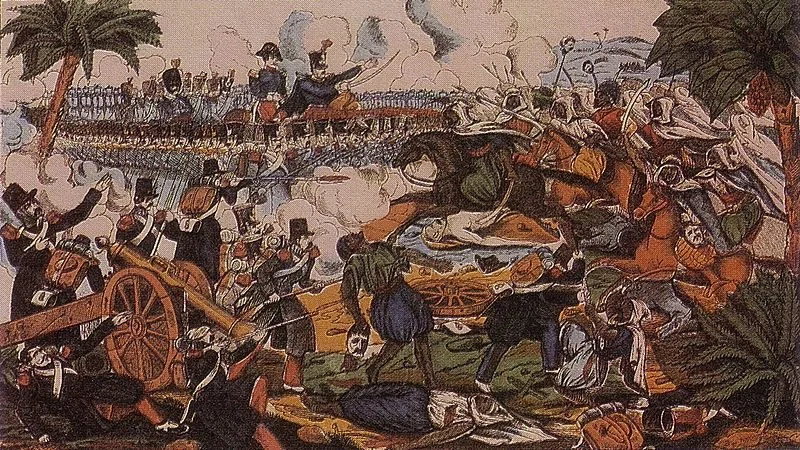
Colonization of Algeria: France began its conquest of Algeria in 1830, making it a settler colony and treating it as an integral part of France, a move that would lead to a brutal war of independence over a century later.
- Political and Intellectual Movements
The Rise of “Isms”: Liberalism, Conservatism, Socialism, and Nationalism became the defining political ideologies, leading to internal conflicts like the Revolutions of 1848.
The American Civil War (1861-1865): Fought over issues of slavery, states’ rights, and national unity, it was a defining crisis for the United States.
The “Short 20th Century” (1914-1991): Crisis, Total War, and Ideological Conflict
This era was dominated by two World Wars, the Great Depression, and the Cold War.
- The World Wars
World War I (1914-1918): The “Great War” was a catastrophic industrial-scale conflict that destroyed old empires (Austro-Hungarian, Ottoman, Russian, German). The punitive Treaty of Versailles (1919) created the conditions for future conflict.
World War II (1939-1945): An even more destructive global war, featuring genocide (the Holocaust) and the use of nuclear weapons. It was a direct battle between democracy, fascism, and communism.
- The Interwar Crisis and the Great Depression
The Great Depression (1929-late 1930s), beginning with the U.S. stock market crash, caused worldwide economic collapse, mass unemployment, and political instability, which fueled the rise of extremist movements.
- The Cold War
A decades-long ideological, political, and proxy struggle between the U.S.-led capitalist West and the Soviet-led communist Eastern Bloc.
Proxy Wars and Interventions: The Cold War was fought indirectly across the globe.
Iran (1953): The U.S. CIA and British MI6 orchestrated a coup to overthrow Iran’s democratically elected Prime Minister, Mohammad Mossadegh, after he nationalized the oil industry, reinstalling the Shah to secure Western oil interests and a Cold War ally.
Algerian War (1954-1962): A brutal war for independence from France. It became a flashpoint in the broader context of decolonization and saw horrific violence from both sides.
Major Assassinations: The era was marked by political violence, most notably the assassination of U.S. President John F. Kennedy (1963), which was a profound national trauma. The killings of Martin Luther King Jr. and Robert F. Kennedy in 1968 further highlighted a period of deep social and political turmoil.
Economic Crises: The Oil Crisis of 1973, triggered by an OPEC embargo in response to Western support for Israel, caused stagflation (high inflation combined with high unemployment) and ended the post-war economic boom.
- Decolonization and Civil Rights
After WWII, European empires rapidly collapsed, and former colonies in Asia and Africa gained independence.
Within the West, major social movements, like the American Civil Rights Movement and second-wave feminism, fought for and won greater equality.
The Contemporary Era (1991-Present): Unipolarity and New Challenges
The collapse of the Soviet Union in 1991 left the United States as the world’s sole superpower.
- The Post-Cold War “New World Order”
Characterized by U.S. dominance, the spread of globalization, and the expansion of the European Union and NATO.
- Rise of Terrorism and the “War on Terror”
The 9/11 attacks (2001) by Al-Qaeda led to the U.S.-led invasions of Afghanistan (2001) and Iraq (2003), initiating a long period of conflict in the Middle East and domestic debates over security and civil liberties.
- Major Economic Crises
The Global Financial Crisis of 2008, triggered by a housing bubble and complex financial derivatives in the U.S., led to the worst global economic recession since the 1930s.
- Political Polarization and the Rise of Populism
The 21st century has seen increasing political fragmentation in both Europe and the U.S., exacerbated by economic inequality, immigration, and the influence of social media. Events like the Brexit referendum (2016) and the storming of the U.S. Capitol (2021) are symptoms of this deep division.
Summary and Key Themes
The history of the West in this period can be understood through several interconnected narratives:
The Application of Power: From direct colonialism to economic and political intervention, Western nations have consistently sought to shape the world to their interests.
Ideological Struggle: The clash between competing systems—monarchy vs. republicanism, fascism vs. democracy, capitalism vs. communism—has been a primary driver of conflict.
Technological and Economic Transformation: The Industrial Revolution and the Digital Revolution have continually reshaped societies, economies, and the nature of warfare.
The Expansion and Contraction of Rights: A long and ongoing struggle to expand civil, political, and social rights to all citizens, often through intense conflict and protest.
This overview provides a framework, but every event listed has deep roots and complex consequences that continue to shape our world today.